Bring Out Your Broken: Why a Repair Café Might Be the Friendliest Hour of Your Week
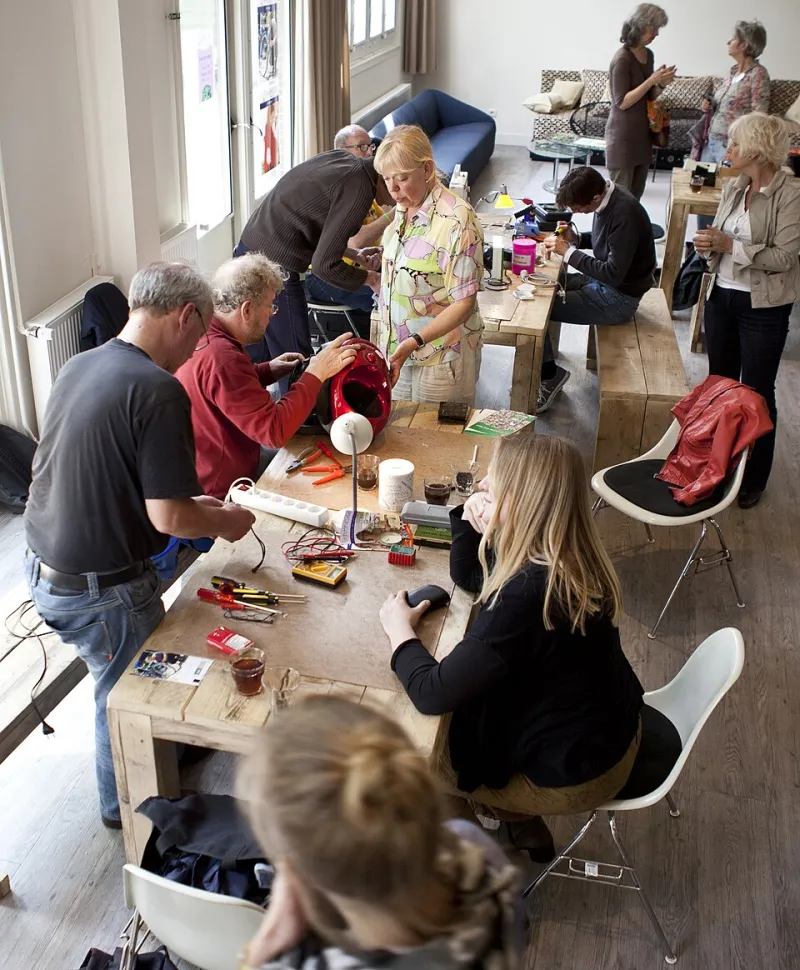
Photo: Ilvy Njiokiktjien, CC BY-SA 3.0, via Wikimedia Commons
The first item through the door is usually a kettle. It is almost always a kettle. Someone carries it in slightly apologetically, as though they are wasting your time, and puts it on the table next to a toaster with a sticky lever and a lamp that has been in the loft since a house move in 2019.
Two hours later the kettle works, the owner has had a cup of tea and a long chat about their daughter's move to Leeds, and a volunteer has learned that a broken switch is usually a two-pound part and twenty minutes of patience. Nobody has saved the planet. But a small thing got fixed, and two people who had only ever nodded at each other across the road now know each other's names.
That, more than the waste figures, is the argument for a repair café.
The most sociable kind of volunteering there is
Most volunteering asks something of you. A shift at the food bank is hard graft. Being a school governor is a stack of evenings and a lot of reading. All of it matters, and none of it is this.
A repair café asks you to sit down, take the back off something, and talk. It is low-commitment, it is indoors, it is on a Saturday morning, and you do not have to be an expert to be useful — someone has to greet people, write the job down, make the tea, hold the torch and stop the queue from getting grumpy. For people who have retired and are quietly going mad, or who have just moved to a new town, or who find big social events exhausting, it is often the easiest way in.
And it cuts a different kind of waste. The UK bins an enormous quantity of small electricals every year, much of it perfectly repair-able, and the rest of it full of parts that could keep something else going. A repair café will not change the world on its own. A few hundred of them, quietly, do make a dent.
What a session actually looks like
You need a hall with tables and good light. You need power sockets near those tables, which is the single most common thing organisers forget. You need a welcome desk, a queue, a few mugs, and a rule that nobody works on anything alone.
A typical morning runs three hours. People arrive with a bag or a box, get booked in at the desk, and are given a rough time slot. A triage volunteer — often the most important person in the room — takes a look, decides whether it is a fixer job, a sewing job, a bike job, or a polite no. Then it goes to a table, and the owner sits alongside while it is worked on.
That last bit is not optional. The whole point is that it is not a drop-off service. Watching someone open your toaster is how people learn that their toaster is not a mysterious black box.
Finding your fixers
Start with the people you already half know. Men's Sheds groups, the University of the Third Age, model railway clubs, the retired electrician three doors down, the person who repairs bikes in their garage, the knitter who can re-darn anything, the teenager who is genuinely good with electronics and would love somewhere to be useful.
Ask the local secondary school's design and technology department. Ask the library. Put a card in the window of the hardware shop — the staff there will know exactly who to point you towards. Ask on the village Facebook group and be specific: we need someone who can look at small electricals, someone who can sew, someone who can do bikes.
You will not get a full team before your first session. You will get four people, and one of them will turn out to be the heart of the whole thing.
The insurance conversation
This is where most well-meaning groups stall for three months.
Speak to the hall first — many church halls and community centres already have public liability cover for the activities they host, but it will not automatically extend to yours. Ask what is included and what you need to add. A small charity, a community association or a local council's community development team can often point you towards an affordable policy, and umbrella organisations exist that will cover a repair café for a modest annual sum.
You will also need a few firm rules, agreed in advance and written on a sign by the door:
- No microwaves, no gas appliances, no anything that has been wet or looks burned.
- Nothing gets plugged in until a competent person has looked at it.
- Mains work is done by someone who knows what they are doing, and is never done alone.
- Everything is tested before it goes home.
- If it cannot be fixed safely, it cannot be fixed here.
- The owner takes it away — nothing is stored overnight unless it is labelled and locked away.
Be clear and unembarrassed about the limits. A repair café is not a service, and it is not a workshop for a full rewire. It is a few hours of help from people with good intentions and reasonable skills.
Booking, triage and keeping the morning calm
Do not let the first session become a free-for-all. Take bookings in advance by phone, email or a form at the library, and hold a couple of slots back for people who turn up on the day. Record only what you need — a name, a phone number, what the item is — and delete it afterwards. Even a small group is handling personal data, and a scrappy notebook that gets left on a table is not ideal.
Post a clear list of what you can and cannot look at. Ask people to bring the plug and the manual if they have it. Ask them to bring the item clean and emptied. Keep a box of spare fuses, plugs and common parts if you can — a lot of fixes come down to something trivial.
Tea and cake are infrastructure
Budget for refreshments properly. Not as an afterthought. A repair café where nobody can get a drink is just a queue with a screwdriver. Put someone in charge of the urn who is happy to be there and is good at talking to strangers, because that person is doing more for the neighbourhood than any of the leaflet campaigns.
Ask for donations rather than setting prices. Most people give generously when their kettle works again, and nobody has to be turned away.
Getting the first morning right
Choose a Saturday, mid-morning, in a hall with a bus stop nearby and parking that does not need a permit. Publicise through every free channel you can think of: the parish newsletter, the shop window, the school gate, the GP surgery, the library noticeboard, the community Facebook page, and — most importantly — people you ask directly.
Expect to fix about half of what comes in. Expect one item to be completely baffling. Expect somebody to ask if you can look at a lawnmower, and to be quietly delighted when you say no.
And expect, by eleven o'clock, to be standing in a slightly too warm hall, holding a mug, listening to two strangers discover they both grew up three streets apart. That is the fix with the longest warranty.