Pinned and Present: Why the Parish Noticeboard Still Beats the Group Chat
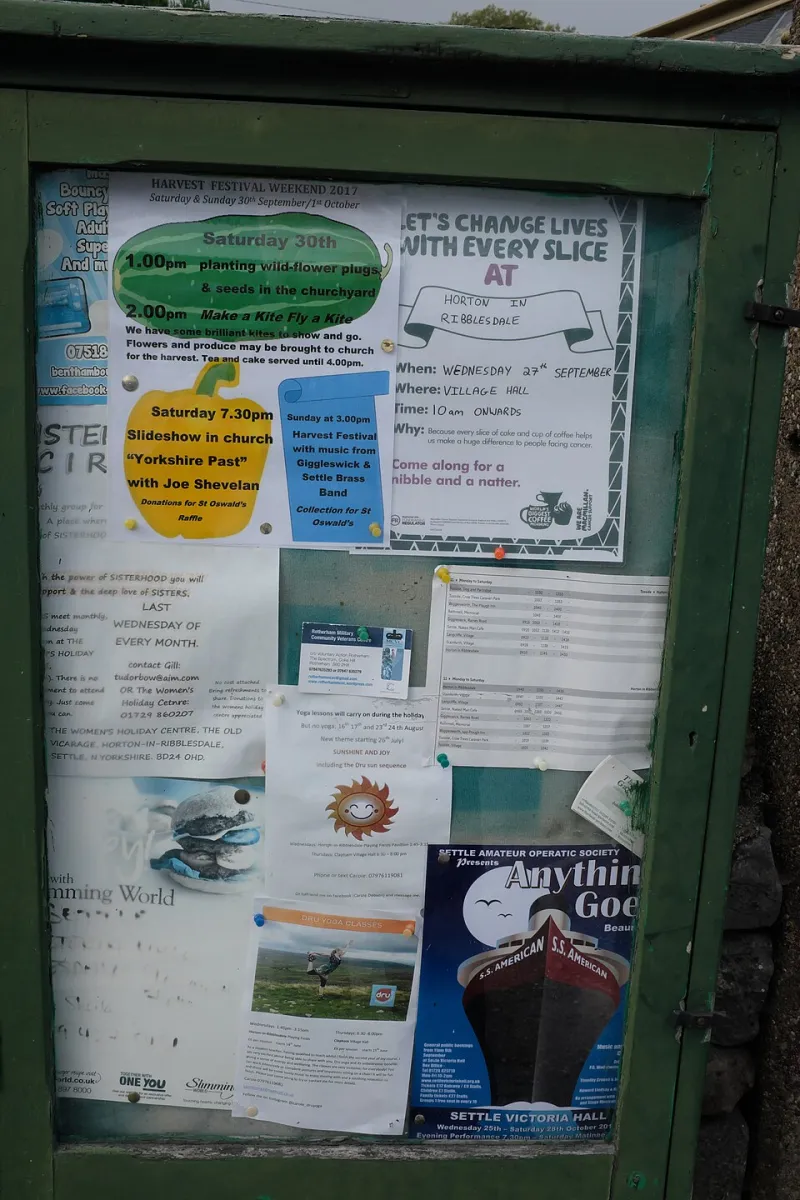
Photo: Bob Harvey , CC BY-SA 2.0, via Wikimedia Commons
There is a noticeboard in the porch of a church near me that has been doing the work of a small citizens’ advice bureau, a lost-and-found desk and a village newsletter for years. It is not digital. It does not ping. Nobody has ever muted it. And yet, on a wet Tuesday, it is often the most useful social network in the postcode.
We are told constantly that physical noticeboards are dying. Everything has moved online, the argument goes. The group chat is where things happen now. But walk past a decent parish post in 2026 and you will see something different: a quiet revival. Not a nostalgic return to cork and drawing pins for their own sake, but a recognition that some kinds of information work better when they are public, slow and stuck at eye level.
The Group Chat Is Brilliant. It Is Also a Closed Door.
Let us be fair to WhatsApp. It is fast, it is free and it is very good at organising a lift to the station or a last-minute plea for someone to take a parcel in. It has kept more neighbourhoods connected than any number of formal meetings. But it has a structural weakness: you have to be in it to see it.
That means the newest resident, the person who has just lost their partner, the family whose first language is not English, the older neighbour who does not use a smartphone and the teenager who has left every group chat in a fit of pique are all outside the room. A noticeboard has no membership list. It does not require a password or a profile picture. It is there for anyone who walks past, and that matters more than we sometimes admit.
A Board Can Do Welfare Signposting Without Feeling Like a Leaflet Drop
One of the quiet strengths of a good community board is that it can carry difficult information without making it the whole story. A poster for a warm space sits next to a notice about a jumble sale. Details of a local food bank collection share space with a card advertising piano lessons. A signpost to the Citizens Advice drop-in is pinned beside a reminder about the parish council meeting.
That mix is not accidental. It means someone who is worried about money can find help without having to announce that they are worried about money. They can look at the board the same way everyone else does—casually, on the way to the post office—and take what they need. There is dignity in that. Not everyone wants to ask a question in a group chat where their neighbour’s cousin can see it.
Trust Is Built in Small, Visible Acts
A noticeboard is also a small lesson in trust. Someone has taken the time to pin up a poster. Someone else has resisted the urge to tear it down. The board is looked after, which means somebody cares about the shared space. That sounds modest, but it is the sort of everyday civic behaviour that holds a street together.
A well-curated board has a curator, even if nobody uses that word. It might be the hall caretaker, a churchwarden, a library volunteer or a member of the parish council. They clear out the events that finished three weeks ago. They take down the poster with the wrong date. They make sure the pins are not rusty and the glass is not smeared. They leave a little space for the handwritten card from a neighbour offering a spare freezer or looking for a lift to the hospital.
That human editing is what separates a noticeboard from a flyposting wall. It says: this is for us, and we are paying attention.
The Digital and the Physical Are Not Enemies
None of this means we should bin the group chat. The strongest community communication is usually a mix. Put the poster on the board and the link in the chat. Share the warm space timetable online and pin it up by the hall door. Use a QR code if you must, but always print the phone number and the time in large, clear type as well. A board should not be a treasure hunt for people without the right app.
There is also a practical advantage to the physical board: it slows information down in a useful way. A group chat can bury a welfare notice under forty messages about a missing cat. A noticeboard keeps it in view for a week. It gives people time to notice, to remember and to act.
How to Make Your Parish Post Pull Its Weight
If your board has become a graveyard of faded fundraising posters, start small. Clear it completely. Give it a wipe. Divide it into three loose zones: events, help and notices. Put the date in the corner of every poster. Ask local services—the library, the surgery, the food bank, the church, the mosque, the community centre—for a current leaflet. Leave a small, clearly labelled space for handwritten cards. Add a line at the bottom: “Want something added? Contact the hall secretary.”
Then watch what happens. Someone will pin up a coffee morning. Someone else will ask for a recommendation for a reliable plumber. A neighbour will advertise a spare mobility aid. A parent will find a holiday club. None of it will go viral. All of it will matter.
The parish noticeboard is not a relic. It is a quiet piece of social infrastructure, and it is doing some of the most patient welfare work in the country. In an age of endless feeds and closed groups, there is something genuinely radical about a public board that anyone can read, for free, without joining anything at all.